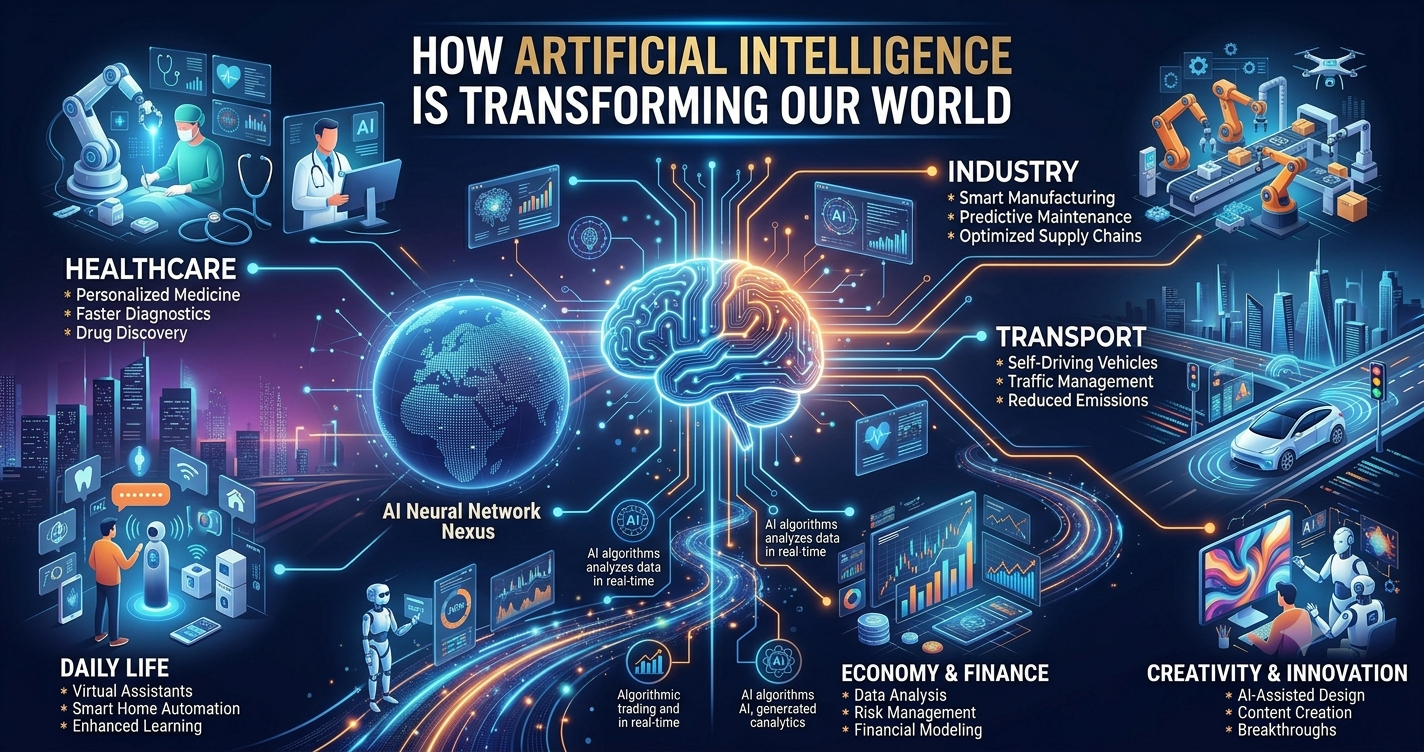
Artificial Intelligence (AI) is no longer a futuristic concept found only in science fiction movies. Today, AI is an integral part of our daily lives, influencing how we work, communicate, travel, shop, and even receive healthcare. As technology continues to evolve, AI is rapidly transforming industries and reshaping the world around us.
What Is Artificial Intelligence?
Artificial Intelligence refers to computer systems designed to perform tasks that typically require human intelligence. These tasks include learning, problem-solving, decision-making, language understanding, and pattern recognition. AI systems use data and algorithms to improve their performance over time, making them increasingly efficient and accurate.
AI in Everyday Life
Many people interact with AI without even realizing it. Virtual assistants like Siri, Alexa, and Google Assistant help users manage schedules, answer questions, and control smart devices. Streaming platforms such as Netflix and Spotify use AI to recommend content based on user preferences. Social media platforms rely on AI to personalize feeds and improve user experiences.
Even online shopping has been transformed by AI. E-commerce platforms analyze browsing behavior and purchase history to provide personalized product recommendations, making shopping faster and more convenient.
Revolutionizing Healthcare
One of the most significant impacts of AI can be seen in healthcare. AI-powered tools assist doctors in diagnosing diseases, analyzing medical images, and predicting patient outcomes. Machine learning algorithms can detect conditions such as cancer at earlier stages, improving treatment success rates.
AI is also accelerating drug discovery by analyzing vast amounts of scientific data. This process helps researchers identify potential treatments faster than traditional methods, potentially saving millions of lives.
Transforming Education
AI is changing how students learn and how teachers teach. Personalized learning platforms can adapt educational content based on a student’s strengths and weaknesses. This customized approach helps learners progress at their own pace and improves overall educational outcomes.
AI-powered tutoring systems provide instant feedback, making learning more interactive and accessible. Additionally, administrative tasks such as grading and scheduling can be automated, allowing educators to focus more on teaching.
Enhancing Business and Productivity
Businesses across various sectors are using AI to improve efficiency and decision-making. AI-powered analytics tools help companies understand customer behavior, predict market trends, and optimize operations.
Automation of repetitive tasks allows employees to focus on creative and strategic work. From customer service chatbots to advanced data analysis systems, AI is helping organizations increase productivity while reducing costs.
AI in Transportation
The transportation industry is undergoing a major transformation thanks to AI. Self-driving vehicle technology is advancing rapidly, with the potential to improve road safety and reduce traffic congestion. AI systems can analyze traffic patterns, optimize routes, and enhance navigation systems.
Ride-sharing companies use AI to match drivers with passengers efficiently, while logistics firms leverage AI to streamline delivery operations and reduce fuel consumption.
Smart Cities and Sustainability
AI is playing a crucial role in developing smart cities. Intelligent systems monitor energy usage, manage traffic flow, and improve public services. These technologies help cities become more efficient, sustainable, and environmentally friendly.
AI can also contribute to climate change solutions by optimizing renewable energy systems, predicting weather patterns, and reducing waste through smarter resource management.
Challenges and Ethical Considerations
Despite its many benefits, AI presents several challenges. Concerns about data privacy, cybersecurity, job displacement, and algorithmic bias continue to grow. Ensuring that AI systems are transparent, fair, and accountable is essential for responsible development.
Governments, businesses, and technology leaders must work together to establish ethical guidelines that balance innovation with public safety and trust
The Future of Artificial Intelligence
The future of AI holds tremendous potential. As technology becomes more advanced, AI will continue to revolutionize industries, solve complex problems, and create new opportunities. From healthcare breakthroughs to smarter cities and more efficient businesses, the possibilities are vast.
However, the true success of AI will depend on how responsibly it is developed and implemented. By focusing on ethical practices and human-centered innovation, society can harness the power of AI to create a better future for everyone.
Conclusion
Artificial Intelligence is transforming our world at an unprecedented pace. It is improving healthcare, education, transportation, business operations, and countless other aspects of modern life. While challenges remain, the benefits of AI are undeniable. As we continue to embrace this powerful technology, AI will play an increasingly important role in shaping a smarter, more connected, and more innovative world.



Leave a Reply